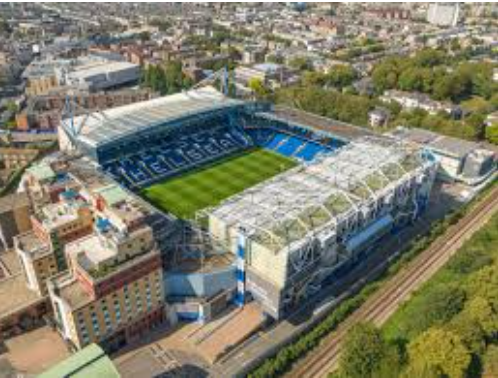
Few grounds are as inseparable from a football club as Stamford Bridge is from Chelsea. Located in West London, the stadium has been the Blues’ home since their formation in 1905 and has witnessed the club’s transformation from a historic London side into a global football powerhouse.
From Athletics Venue to Football Home
Stamford Bridge existed before Chelsea did. It opened in 1877 as an athletics venue and only became the home of the newly established Chelsea Football Club in 1905.
The ground has changed dramatically over the decades. What began as a vast oval arena was gradually reshaped into the more compact football stadium recognised today. The East Stand opened in 1974, while extensive redevelopment during the 1990s and early 2000s created much of the modern Stamford Bridge.
Despite those changes, the club has never moved from its original Fulham location. That continuity has helped preserve Stamford Bridge’s place at the centre of Chelsea’s identity for more than 120 years.
The Start of Chelsea’s Rise
Chelsea had tasted success before the Premier League era, winning the English championship in 1955. However, the early 21st century changed the scale of the club’s ambitions.
Under José Mourinho, Chelsea won the 2004-05 Premier League title with 95 points, ending a 50-year wait to be crowned champions of England. They retained the title the following season, establishing themselves as one of the country’s leading forces.
Stamford Bridge became a difficult destination for visiting teams during this period. A powerful squad, backed by supporters who had grown accustomed to challenging for major honours, helped turn home matches into a defining advantage.
Players Who Shaped the Bridge
Chelsea’s modern success was built by a group of players who became inseparable from the stadium’s story. John Terry led from central defence, Frank Lampard combined goals with leadership from midfield, and Didier Drogba built a reputation for delivering when the stakes were highest.
Petr Cech, Ashley Cole and Claude Makelele also helped set the standards that defined Chelsea’s rise. Later generations, including Eden Hazard and N’Golo Kante, carried that tradition forward.
For supporters hoping to see the current squad at Stamford Bridge, TicketKosta offers a way to explore Chelsea football tickets and arrange a visit to the club’s historic West London home.
Premier League Success
Chelsea’s first two Premier League titles were followed by further championships in 2009-10, 2014-15 and 2016-17. Each success came under a different manager and with a different style of play, but Stamford Bridge remained central to every campaign.
The 2009-10 season stands out as one of the club’s most productive. Carlo Ancelotti’s side scored 103 league goals while completing a Premier League and FA Cup Double.
Antonio Conte later guided Chelsea back to the summit in 2016-17 after switching to a 3-4-3 system. Across these different eras, strong home form repeatedly provided the foundation for title challenges.
European Nights at the Bridge
Chelsea’s domestic achievements were matched by a growing presence in European competition. The club first appeared in Europe’s leading club competition in 1999 and gradually turned Stamford Bridge into a stage for major continental fixtures.
Memorable clashes with Barcelona, Liverpool and other elite European sides helped build the ground’s reputation. Chelsea went on to win the Champions League in 2012 and again in 2021, confirming their status as one of Europe’s leading clubs.
Stamford Bridge is therefore associated not only with Premier League success, but also with some of the most dramatic nights in Chelsea’s European history.
A Stadium with Character
Stamford Bridge differs from many newer Premier League venues. Its capacity of around 40,000 is smaller than several rival grounds, while its location in a densely built part of West London restricts the space available for expansion.
That compactness, however, gives the stadium much of its character. The stands sit close to the pitch, creating an enclosed atmosphere in which crowd noise can rise quickly during decisive moments.
Rather than feeling detached from its surroundings, Stamford Bridge remains embedded in the neighbourhood around it.
The Heart of Chelsea
Chelsea’s modern history includes league titles, domestic cups and major European trophies, but Stamford Bridge connects every era. It has watched the club evolve from a traditional London side into one of the most recognisable names in world football.
Managers will change, squads will be rebuilt and new stars will emerge, but the Bridge remains the constant. For supporters walking through Fulham on a matchday, it is more than a place to watch football.
Stamford Bridge is the physical home of Chelsea’s history, identity and modern success, the stage on which the club’s next chapter will continue to unfold.