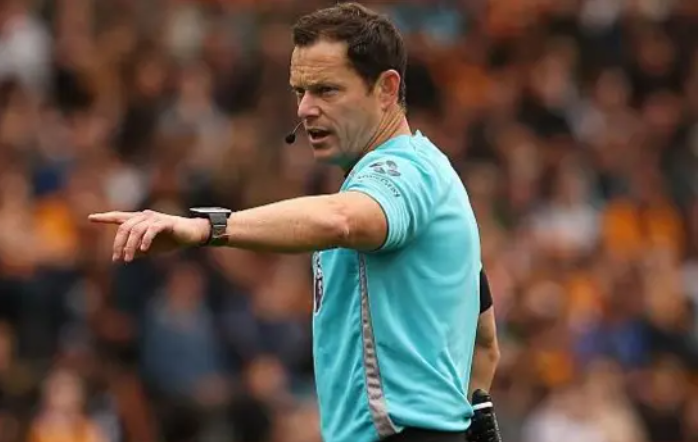
Few officials understand the emotional extremes of elite refereeing better than Darren England. Three years ago, a VAR mistake during Liverpool’s match at Tottenham left the South Yorkshire referee facing intense scrutiny; today, he is regarded as one of the Premier League’s most trusted officials both on the pitch and in the VAR room.
England’s recovery has been remarkable. During 2026, he has been entrusted with major fixtures, including Manchester City’s 1-0 FA Cup final win over Chelsea, and has now been promoted to Champions League VAR duty for the first time, for Galatasaray against Stuttgart.
The mistake that changed everything
The incident occurred in September 2023, when Luis Diaz scored for Liverpool at Tottenham only for the goal to be ruled out for offside. England, acting as VAR, confirmed “check complete” despite the offside image showing Diaz was onside, leaving the goal disallowed.
The error was later described by PGMOL as a “significant human error.” England and assistant VAR Dan Cook were removed from their next assignments, while Liverpool said the episode had undermined sporting integrity.
England acknowledges it was the lowest point of his career. He says the pressure of realising the mistake, while still needing to officiate the remainder of the match, demanded enormous resilience and experience.
Life inside the VAR hub
England says modern refereeing has changed dramatically since he swapped his assistant’s flag for a whistle 11 years ago. Officials now carry communication equipment and work within an environment where every major decision can be reviewed in seconds.
He rejects the suggestion that referees use VAR as a safety net rather than making their own judgments. In his view, playing on means he does not believe an offence meets the threshold for intervention; VAR is there to correct clear and obvious errors, not to replace on-field decision-making.
The VAR hub, he explains, is a high-pressure and mentally draining space. There is no crowd atmosphere or commentary, only the voices of the officiating team through headsets, and a busy match can leave an official mentally exhausted by full-time.
Scrutiny that reached his family
The aftermath of the Diaz controversy extended far beyond football. England says the story dominated newspapers, radio phone-ins and social media for days, while photographers gathered outside his children’s school and family photographs were taken from his wife’s Facebook account.
He says that level of attention affected him not only as a referee but as a father and husband. England was removed from Premier League selection, did not referee a top-flight match for almost three months, and waited six-and-a-half months before returning to VAR duty.
His rehabilitation included work with a sports psychologist and support from the Football Association, Professional Game Match Officials Limited, family and friends. He was gradually reintroduced through FA Cup appointments, with Michael Oliver supporting him as VAR.
Rebuilding trust at the top
England’s persistence has been rewarded with high-profile appointments. He was the VAR when West Ham’s stoppage-time equaliser against Arsenal was disallowed in May, a decision widely described as one of the biggest VAR calls ever, before taking charge of the FA Cup final six days later.
He describes refereeing the FA Cup final as a career highlight and a genuine honour. For a referee who once feared his career had stalled, returning to Wembley for English football’s showpiece domestic final represented a powerful reversal.
England says he avoids social media because constant criticism can affect performance, though he understands other officials make different choices. He also says referees cannot fully switch off from football, with parents often questioning decisions during the school run.
A role model among referees
England’s standing among colleagues was underlined at a Professional Referee Group training camp at Loughborough University. Director Hugh Dallas introduced him as a “role model” as he celebrated his 100th Premier League match, receiving a plaque and medal in front of fellow officials.
His journey began in Royston, near Barnsley, where he qualified as a referee at 15. He initially combined coaching at Barnsley’s academy with weekend officiating before choosing refereeing as his professional path.
England first reached the Premier League as an assistant referee, then made the bold decision in 2015, aged 28, to restart in the National League as a referee. Within four and a half years, he was taking charge of top-flight matches.
Champions League next
Uefa has followed England’s progress closely, gradually moving him through European competitions. After 10 Conference League appointments and six in the Europa League, his promotion to Champions League VAR duty marks another major milestone.
England says Premier League players continue to improve, so officials must keep developing too. His ambitions remain clear: more major finals, including the Carabao Cup final and the Championship play-off final.
Three years ago, an FA Cup final and Champions League involvement seemed distant after the Diaz error. Now, England has rebuilt his reputation through resilience, accountability and consistent performances at the highest level.