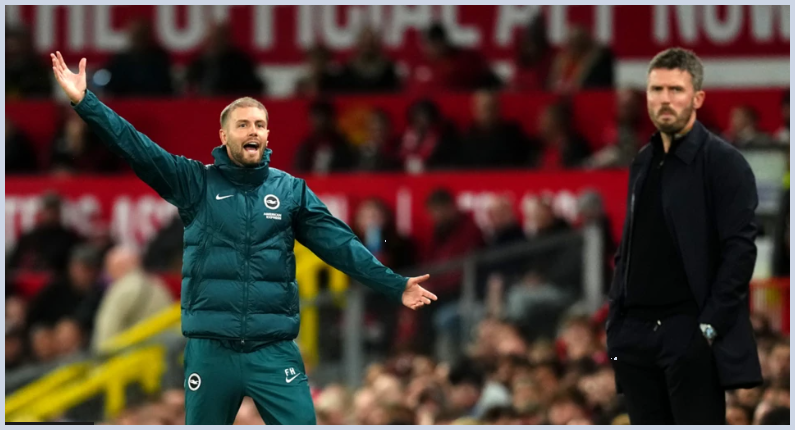
Michael Carrick is the latest Manchester United manager to find himself trapped in a familiar cycle: poor results, growing dressing-room tension, fan frustration and eventually the threat of dismissal.
Since Sir Alex Ferguson retired in 2013, United have appointed seven full-time managers. Each arrived with a different plan, reputation or philosophy. Yet every one eventually left without restoring the club to its former dominance.
The question now is no longer simply whether Carrick can survive. It is whether Manchester United have become so unstable, so poorly led and so damaged by years of bad decisions that the Old Trafford job has become almost impossible to manage.
Carrick Faces a Familiar United Story
Carrick’s apology to supporters after United’s 4-1 Champions League defeat at Como echoed Ole Gunnar Solskjaer’s response following a similar defeat at Watford in November 2021. Solskjaer was sacked shortly afterwards.
Carrick is now the seventh permanent manager since Ferguson stepped down after winning 38 trophies in 26 years. David Moyes, Louis van Gaal, Jose Mourinho, Solskjaer, Erik ten Hag, Ruben Amorim and Carrick have all tried to rebuild the club.
There have been brief moments of success. Van Gaal won the FA Cup in 2016. Mourinho added the League Cup and Europa League in 2017. Ten Hag won the FA Cup in 2024 after beating Manchester City at Wembley.
But those trophies feel like small rewards compared with United’s past. The bigger pattern remains unchanged: hope, short-term improvement, decline, crisis and dismissal.
Dressing-Room Tension Adds to the Crisis
Carrick’s position has become even more fragile because the problems are no longer limited to results.
Defender Lisandro Martinez publicly criticised director of football Jason Wilcox after United’s Champions League defeat at Atletico Madrid. Captain Bruno Fernandes then questioned the team’s tactics following the loss to Como.
Those incidents suggest a squad that is losing confidence in the direction of the club. When senior players begin openly questioning leadership, a manager’s authority comes under immediate pressure.
United’s hierarchy reportedly fears that Carrick is losing the dressing room. With results poor and morale low, the manager now needs a rapid improvement to change the narrative.
Is the Problem Bigger Than the Manager?
It is easy to blame every United manager when results collapse. But the repeated failures raise a more uncomfortable question: is the real issue at Old Trafford above the dugout?
United’s leadership has changed over the years, from former executive vice-chairman Ed Woodward to the Glazer family and now part-owner Sir Jim Ratcliffe. Yet the club has continually struggled to create a clear, stable footballing structure.
Different types of managers have been tried. Moyes arrived as Ferguson’s chosen successor but found the scale of the job overwhelming. Van Gaal and Mourinho were established winners at Europe’s biggest clubs. Ten Hag earned his opportunity after leading Ajax to a Champions League semi-final. Amorim was viewed as one of Europe’s most exciting young coaches.
All were eventually sacked.
That pattern suggests the problem is not simply about hiring the wrong manager. It is about appointing managers without a long-term plan, changing direction too often and failing to build a stable footballing identity.
Missed Opportunities and Poor Appointments
United’s decline did not happen suddenly. It began with a poorly handled succession plan after Ferguson’s departure.
Carlo Ancelotti, Pep Guardiola and Jurgen Klopp were all linked with Old Trafford at different stages. Instead, by December 2019, Ancelotti was at Everton, Guardiola was at Manchester City and Klopp was at Liverpool, while United had Solskjaer in temporary charge.
Solskjaer was eventually given the job permanently after a strong interim spell. But his previous managerial record, including a short and unsuccessful spell at Cardiff City, offered little evidence that he could rebuild a club of United’s scale.
Carrick’s appointment now feels similar. Like Solskjaer, he is a former United player and fan favourite who impressed during a temporary period in charge. But his previous full-time managerial role at Middlesbrough ended in dismissal.
United may once again have chosen familiarity over a long-term footballing strategy.
Ratcliffe’s Leadership Under Scrutiny
Sir Jim Ratcliffe’s arrival was meant to bring sharper decision-making and a return to footballing common sense. Instead, instability has continued.
United came close to sacking Ten Hag before the 2024 FA Cup final. His victory over Manchester City saved his job, and the club then extended his contract and gave him around £200m for transfers. Six months later, he was dismissed, with the cost of ending his and his staff’s contracts exceeding £10m.
The handling of sporting director Dan Ashworth was equally damaging. Ashworth joined from Newcastle in July 2024 with a strong reputation but left just five months later after a behind-the-scenes disagreement. He had spent almost as long on gardening leave before joining United as he did actually working at the club.
Amorim’s appointment also raised questions. His commitment to a 3-4-3 system was already a concern for some clubs, yet United pursued him anyway. His reign lasted only 14 months and ended after a difficult relationship with the hierarchy.
Fan Anger and Financial Pressure
Supporter frustration has also grown. Fans have protested against the Glazer family since their leveraged takeover in 2005, arguing that the purchase loaded debt onto the club.
Ratcliffe’s part-ownership alongside the Glazers has not eased that anger. Many supporters see his involvement as a continuation of the same ownership structure rather than a genuine reset.
Off-field tension increased further after United launched an investigation into alleged ticket-touting. The club later admitted it had underestimated how many supporters shared account details and softened some of its warnings over season-ticket confiscation.
Financially, the picture remains mixed. United announced record revenue of £678m and a £23m operating profit, a major improvement from the £113m loss recorded in 2023-24. However, overall debt remains around £1bn despite Ratcliffe’s cost-cutting measures.
The club has also spent £64m buying land for a proposed new stadium. Ratcliffe hopes the planned 100,000-capacity venue, estimated to cost more than £2bn, will become part of his legacy.
Can Anyone Fix Manchester United?
Manchester United will always be able to find a manager. But they may no longer be able to attract the very best candidates easily.
The club must convince a top coach that Old Trafford offers a genuine long-term project rather than another short-lived appointment. That is a difficult sell when recent history suggests that even successful managers can leave within a few years.
United’s squad also needs major improvement. Even a highly experienced manager may struggle to deliver a quick fix without significant investment, better recruitment and a clearer footballing structure.
Carrick is currently the most visible figure in United’s crisis, and he may ultimately pay the price for failures that began long before his appointment. But the deeper issue is the repeated cycle of poor planning, unstable leadership and short-term thinking.
Until that changes, Manchester United risk remaining a club where managers arrive with hope and leave with regret.