From European glory to second-tier grit, West Ham United’s trajectory has taken a sharp turn. Just three years after Declan Rice lifted the Europa Conference League trophy in 2023—the club’s first major honour in 43 years, the Hammers are preparing for life in the Championship. Back-to-back European campaigns, including a Europa League semi-final and a 2024 quarter-final, alongside sixth- and seventh-place Premier League finishes in 2021 and 2022, had made relative success feel routine in east London. Yet football’s volatility has caught up, and for the first time in 14 years, West Ham will compete outside the top flight.
Installed as early favourites for an immediate return, the Irons last achieved instant promotion in 2011–12. But the English Football League (EFL) remains notoriously unforgiving, even for a club operating from the biggest stadium in Championship history. With an ownership tug of war simmering behind the scenes, the 2026–27 campaign could define the next era at the London Stadium.
The Championship precedent: cautionary tales and blueprints
Recent history shows divergent paths for big clubs dropping into the second tier. Newcastle United bounced straight back in 2010 and 2017, handling adversity with relative ease. Aston Villa needed three years after 2016, enduring a 13th-place finish and a play-off final defeat before finally returning.
Other stories underline how quickly momentum can evaporate. Leicester City, champions a decade ago, now face League One just two seasons after relegation. Blackburn Rovers, 1995 title winners and regular Europeans in the late 1990s, fell to the Championship in 2012 and then to League One in 2017, still searching for a way out of the EFL grind. Leeds United dropped in 2005, only to spend 16 years outside the Premier League, including a spell in the third tier.
For West Ham, the lesson is clear: favourites status offers no guarantees in a 46-game marathon packed with midweek fixtures and relentless travel.
Bowen and Nuno: the twin pillars of promotion hopes
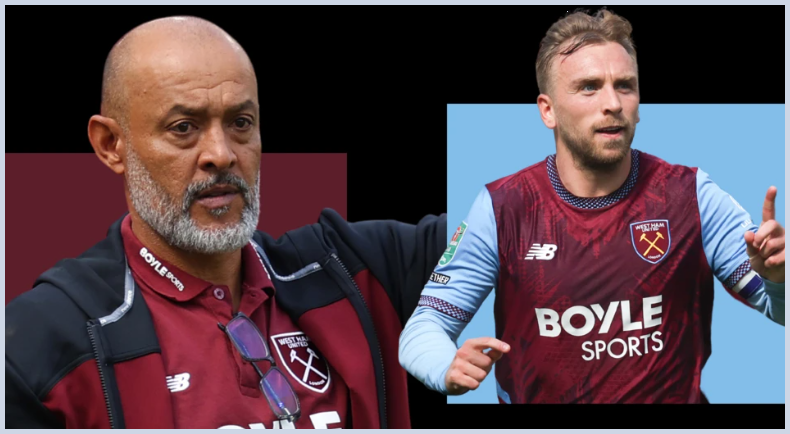
At the heart of West Ham’s push is captain Jarrod Bowen, the match-winner against Fiorentina in the 2023 European final. His decision to commit his future to the club is viewed internally as more valuable than any summer signing. Bowen has been the Hammers’ top scorer in four of the last five seasons, netting 76 goals in 227 appearances and adding 53 assists. He signalled early intent with a goal and an assist in a 3–1 EFL Cup win over Portsmouth.
“It was a no-brainer for me to be here and the vision is clear,” Bowen said. “It’s the Premier League.” Still, the 29-year-old England international is under no illusions about the challenge ahead. “It’s 46 tough games, midweek, Saturday, Tuesday, Friday… There’s going to be disappointment at times, there’s going to be a lot of pressure on us to go and win the league straight away.”
Manager Nuno Espírito Santo shares that realism. “Normally when a team drops to the Championship, you have to be the favourite, mainly because our objective is to go back to the Premier League,” he told BBC Radio London. “We realise how hard it’s going to be. We’re going to have to be resilient, to keep going. Tight schedule, very tough competition, a lot of good teams with the same aspirations as ourselves. But we are ready for the challenge.”
Why keeping Nuno matters: experience, stability, and squad buy-in
Retention of key personnel is arguably West Ham’s biggest advantage in 2026–27. Unlike Burnley (new boss Nicky Hayen) and Wolves (Cesar Peixoto), the Hammers have kept their manager. Nuno’s prior success, winning the Championship with Wolves in 2017–18 to secure promotion, gives him a proven blueprint.
Former defender Luke Chambers described Nuno’s continuation as “almost like having an £80m signing coming in,” calling it a “massive coup” for a relegated side. The board’s public backing followed intense internal debate, with reports of a split before the decision to retain the Portuguese coach was confirmed. Club statements emphasised Nuno’s motivation to deliver instant promotion and the board’s belief in his project despite the financial hit of relegation, estimated at around £200m in lost income.
The wider context: odds, expectations, and the ownership backdrop
Bookmakers and models alike rate West Ham as clear favourites. Early Championship promotion odds placed the Hammers around 1/2 for a top-two finish and 7/4 to win the title outright, reflecting an implied high probability of an immediate bounce-back. The Opta supercomputer also lists West Ham as favourites for both the title and automatic promotion.
Yet expectations carry risk. Anything short of automatic promotion would be viewed as a failure given the squad’s quality and resources. Off the pitch, an ongoing ownership saga adds complexity, with questions over investment, strategy, and long-term direction. Nuno has insisted that transfer funding is not a problem, but the broader financial picture remains a talking point as the club navigates a reduced revenue environment.
The path forward: resilience, depth, and the 46-game test
West Ham’s promotion case rests on three pillars: Nuno’s Championship experience, Bowen’s leadership and output, and the club’s ability to maintain squad depth across a gruelling calendar. The Hammers must convert favourite status into consistency, avoiding the slips that have derailed other big names in the EFL.
If they manage the ownership noise, keep key figures on board, and handle the physical and mental demands of the second tier, an instant return to the Premier League is well within reach. But as recent history shows, the Championship rarely yields easy passage, even for the biggest clubs.